
Marine Oils & Lubricants South Africa | TOSOG Yellow Plant Solutions
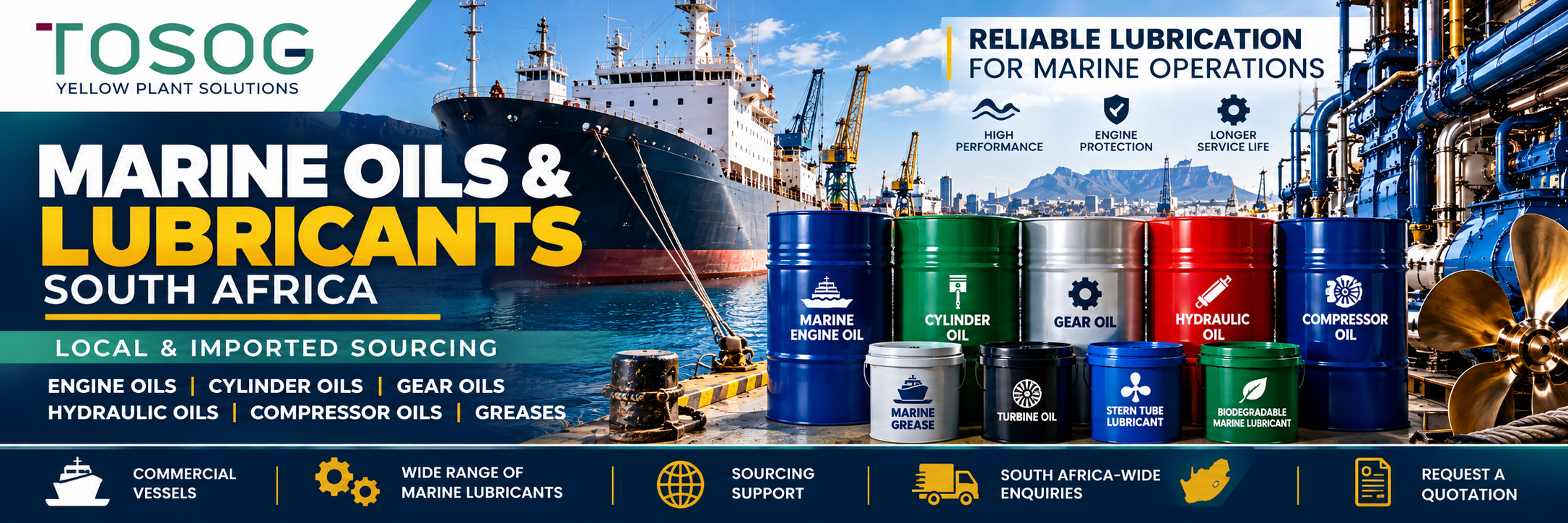 Marine Engine Oils | Marine Lubricants | Gear Oils | Hydraulic Oils | Transmission Oils | Greases | Local & International Sourcing
Your Trusted Source for Marine Oils and Lubricants in South Africa
TOSOG Yellow Plant Solutions provides sourcing solutions for marine oils and lubricants in South Africa, supporting vessel operators, marine engineering companies, shipowners, fishing fleets, offshore operators, marine workshops, ports, and industrial marine service providers.
We assist customers with sourcing marine engine oil, diesel engine lubricants, marine gear oil, hydraulic oil, compressor oil, transmission oil, industrial lubricants, and marine grease from established lubricant manufacturers and international supply channels.
Whether you require lubricants for commercial vessels, marine generators, auxiliary engines, propulsion systems, hydraulic equipment, or onboard machinery, TOSOG can assist with identifying suitable products based on your equipment specifications, operating conditions, and manufacturer recommendations.
Our sourcing network supports both locally available products and imported marine oils and lubricants, subject to product availability, manufacturer approval, and delivery requirements.
Looking for marine oil suppliers in South Africa? Contact TOSOG with your equipment details, required lubricant specification, product quantity, and delivery location for assistance with sourcing and quotations.
Our Marine Oil and Lubricant Product Range
- Marine diesel engine oils
- Trunk piston engine oils
- Crosshead engine cylinder oils
- Marine generator engine oils
- Marine gearbox and transmission oils
- Marine hydraulic oils
- Marine compressor oils
- Marine turbine oils
- Marine gear lubricants
- Marine greases and bearing lubricants
- Stern tube lubricants
- Environmentally acceptable lubricants (EALs)
- Coolants and antifreeze products
- Industrial oils for marine support equipment
- Specialty lubricants for offshore and marine applications
Product availability depends on the manufacturer, required specification, packaging, and order quantity.
Marine Engine Oils and Lubricants for Different Applications
Selecting the correct marine lubricant is essential for protecting engines, reducing wear, maintaining equipment reliability, and controlling maintenance costs.
Marine machinery operates under demanding conditions, including continuous operation, high temperatures, heavy loads, saltwater exposure, moisture, and variable engine loads. The correct lubricant must therefore meet the requirements of the specific engine or equipment manufacturer.
TOSOG assists customers with sourcing suitable marine lubricants for the following applications.
1. Marine Diesel Engine Oil
Marine diesel engine oil is used to lubricate engine components, reduce friction, control deposits, and protect against wear and corrosion.
Depending on the engine design, operating conditions, and manufacturer recommendations, marine diesel engine lubricants may include trunk piston engine oils and crosshead engine system oils.
Typical applications include:
- Commercial marine diesel engines
- Fishing vessel engines
- Workboat engines
- Auxiliary marine engines
- Marine generator sets
- Tugboat and support vessel engines
When sourcing marine engine oil, always confirm the engine manufacturer’s recommended viscosity grade, performance category, and lubricant approval.
2. Trunk Piston Engine Oils
Trunk piston engine oils are commonly used in medium-speed four-stroke marine diesel engines.
These lubricants are formulated to provide engine cleanliness, wear protection, oxidation resistance, and control of deposits under demanding operating conditions.
Applications may include:
- Medium-speed marine diesel engines
- Marine auxiliary engines
- Diesel generator sets
- Commercial vessel propulsion systems
- Certain stationary and offshore power generation applications
The required oil must be selected according to the engine manufacturer’s specifications and fuel conditions.
3. Crosshead Engine Cylinder Oils
Crosshead engine cylinder oils are designed for the cylinder lubrication requirements of large, low-speed two-stroke marine diesel engines.
The appropriate cylinder oil depends on factors such as engine design, fuel sulphur content, operating conditions, and the engine manufacturer’s lubrication recommendations.
Important selection considerations include:
- Base number (BN) or total base number (TBN)
- Cylinder lubrication requirements
- Fuel sulphur content
- Deposit control
- Engine manufacturer approval
- Operating load and temperature
Important: Cylinder oil and system oil are not interchangeable simply because both are used in a marine engine. Always follow the engine manufacturer’s lubrication guidance.
4. Marine Gearbox and Transmission Oil
Marine gear oils lubricate gears, bearings, and related components in marine propulsion and auxiliary drive systems.
Depending on the equipment, the required lubricant may be an industrial gear oil, marine transmission fluid, or a specialist lubricant approved for the particular gearbox.
Applications include:
- Marine reduction gearboxes
- Propulsion transmission systems
- Auxiliary drive systems
- Marine winches and gear drives
- Certain deck machinery systems
Before ordering, confirm the required viscosity, lubricant type, additive requirements, and gearbox manufacturer’s approval.
5. Marine Hydraulic Oil
Marine hydraulic oil is used in hydraulic systems that control machinery and equipment aboard vessels and offshore installations.
Typical applications include:
- Hydraulic steering systems
- Deck cranes
- Winches and lifting equipment
- Hydraulic power packs
- Stabilisation systems
- Marine auxiliary machinery
The correct hydraulic oil must meet the equipment manufacturer’s viscosity and performance requirements. Where equipment is exposed to the sea or sensitive marine environments, an environmentally acceptable hydraulic lubricant may be appropriate if specifically approved for the application.
6. Marine Compressor Oil
Marine compressor oils are designed for the lubrication requirements of compatible air and gas compressors.
Applications may include:
- Marine workshop compressors
- Instrument air compressors
- Auxiliary air systems
- Certain refrigeration compressor systems
- Offshore compressed-air equipment
Compressor lubricant requirements vary according to compressor design, operating temperature, gas type, and manufacturer recommendations. Refrigeration compressors may require specialised oils that are not interchangeable with conventional air compressor oils.
7. Marine Greases and Bearing Lubricants
Marine greases are used to lubricate bearings, joints, pins, and other moving components exposed to moisture, salt, and heavy operating loads.
Depending on the application, customers may require:
- Marine water-resistant grease
- Calcium sulphonate complex grease
- Lithium complex grease
- High-temperature bearing grease
- Heavy-duty EP grease
- Specialist environmentally acceptable grease
The grease must be compatible with the equipment, operating temperature, existing lubricant, and sealing materials.
8. Environmentally Acceptable Marine Lubricants
Environmentally acceptable lubricants (EALs) are designed to reduce environmental impact in applications where lubricant leakage or release into the marine environment may occur.
Potential applications include:
- Stern tubes
- Thrusters
- Deck machinery
- Hydraulic systems
- Offshore equipment
- Other environmentally sensitive marine applications
EAL products vary in their environmental properties, approvals, and technical suitability. Always verify the applicable environmental requirements and equipment manufacturer’s approval before selecting a product.
Marine Oil Models, Types and Specifications
Marine oils are generally identified by their application, viscosity grade, performance category, and manufacturer-specific approval.
The following table provides examples of common marine lubricant categories and viscosity grades. It is a sourcing guide, not a substitute for an equipment manufacturer’s approved lubricant list.
| Marine Oil Type | Common Grades or Categories | Typical Application |
|---|---|---|
| Marine diesel engine oil | SAE 15W-40, SAE 40 | Marine diesel engines, where specified |
| Trunk piston engine oil | SAE 30, SAE 40 | Medium-speed four-stroke marine engines |
| Crosshead engine cylinder oil | SAE 50; application-specific BN | Large, low-speed two-stroke marine engines |
| Marine system oil | SAE 30, SAE 40 | Compatible crosshead engine system lubrication |
| Marine gear oil | ISO VG 150, 220, 320 | Marine gearboxes and gear drives |
| Marine hydraulic oil | ISO VG 32, 46, 68 | Hydraulic power packs and machinery |
| Marine compressor oil | ISO VG 32, 46, 68, or other specified grades | Compatible compressor systems |
| Marine turbine oil | ISO VG 32, 46 | Compatible turbine and auxiliary equipment |
| Marine bearing grease | NLGI Grade 1, 2, or other specified grade | Bearings and rotating equipment |
| Marine water-resistant grease | Application-specific NLGI grade | Equipment exposed to water and moisture |
| Marine coolant | Manufacturer-specific formulation | Engine cooling systems |
| Environmentally acceptable lubricant | Product-specific grades and approvals | Environmentally sensitive marine equipment |
Important: SAE viscosity grades, ISO viscosity grades, engine oil performance categories, and lubricant approvals describe different properties. They must not be treated as interchangeable specifications.
Marine Lubricant Specification Checklist
When requesting a quotation for marine oil, provide as much of the following information as possible:
- Equipment manufacturer and model
- Engine or gearbox model
- Equipment serial number, where available
- Required oil type
- Required viscosity grade
- Manufacturer lubricant specification or approval
- Required quantity in litres or kilograms
- Packaging requirement, such as 20-litre pails, 25-litre containers, 200-litre drums, or bulk supply
- Vessel location or delivery address
- Preferred manufacturer or acceptable alternatives
This information helps reduce the risk of ordering an unsuitable lubricant.
Marine Oil Manufacturers and Brands
TOSOG can assist with sourcing marine oils and lubricants from established international lubricant manufacturers, subject to product availability, supply arrangements, and the required technical specification.
The following manufacturers have marine, industrial, engine lubrication, or related lubricant portfolios. Not every manufacturer offers every marine lubricant category in every market.
Shell Marine Lubricants
Shell has a dedicated marine lubricants portfolio covering selected marine engine oils, cylinder oils, system oils, and other marine lubrication products.
Potential applications include:
- Marine diesel engine lubrication
- Large two-stroke engine cylinder lubrication
- Medium-speed engine lubrication
- Auxiliary machinery
Product selection should be based on the specific engine model and the current manufacturer approval list.
Mobil Marine and Industrial Lubricants
Mobil offers lubricant products for various industrial and marine-related applications, depending on the product range available in the market.
Potential product categories include:
- Engine oils
- Gear oils
- Hydraulic oils
- Compressor oils
- Industrial lubricants
Always confirm whether the selected product is approved for the intended marine equipment.
Castrol Marine Lubricants
Castrol has offered marine lubricant products for a range of marine engine and equipment applications.
Depending on availability and product specification, relevant categories may include:
- Marine engine lubricants
- Cylinder oils
- System oils
- Industrial lubricants
Verify current product availability and approvals before ordering.
TotalEnergies Lubricants
TotalEnergies supplies lubricant products for industrial, engine, and marine-related applications.
Potential categories include:
- Marine engine oils
- Industrial gear oils
- Hydraulic oils
- Compressor oils
- Specialty lubricants
Product selection must be based on the required technical specification rather than brand alone.
FUCHS Lubricants
FUCHS offers a broad range of industrial lubricants and specialty lubrication products.
Potential applications include:
- Hydraulic systems
- Gearboxes
- Bearings
- Industrial machinery
- Specialist lubrication requirements
Confirm the suitability of the specific product for marine service and the applicable equipment approval.
Other Marine Lubricant Manufacturers
Depending on the specification and sourcing requirements, other manufacturers may be considered, including:
- Chevron
- Gulf Oil
- ENEOS
- PETRONAS Lubricants
- Klüber Lubrication
- RAVENOL
The inclusion of a manufacturer does not mean that every listed brand supplies every type of marine oil or that TOSOG holds authorised distributorships for these brands.
TOSOG sourcing commitment: We assist with identifying suitable products against the customer’s technical requirements and sourcing locally available or imported options where possible.
Marine Oil Brands Comparison Table
The following comparison is intended to help buyers evaluate potential lubricant suppliers. Actual suitability depends on the specific product, equipment approval, availability, and commercial terms.
| Manufacturer | Main Relevant Product Areas | Best Selection Criteria |
|---|---|---|
| Shell | Marine engine oils, cylinder oils, system oils and selected marine lubricants | Exact engine application and current approval |
| Mobil | Engine oils and industrial lubricants | Required viscosity, performance and equipment compatibility |
| Castrol | Marine and industrial lubrication products | Current product availability and engine approval |
| TotalEnergies | Engine oils, hydraulic oils, gear oils and industrial lubricants | Technical specification and application |
| FUCHS | Industrial oils, greases and specialty lubricants | Equipment requirements and lubricant compatibility |
| Chevron | Engine and industrial lubricants | Required performance level and OEM recommendation |
| Gulf Oil | Engine and industrial lubricant categories | Specification, availability and application suitability |
| ENEOS | Engine and industrial lubricant products | Product-specific performance and equipment requirements |
| PETRONAS Lubricants | Engine and industrial lubricant categories | Manufacturer requirements and local availability |
| Klüber Lubrication | Specialty lubricants and greases | Specialist application and equipment approval |
| RAVENOL | Engine oils and industrial lubricant products | Exact product specification and suitability |
How should you choose a marine oil brand?
The best lubricant is not necessarily the most expensive or the most widely advertised. Prioritise the exact equipment manufacturer’s requirements, the product’s technical data sheet, documented approvals, operating conditions, supply continuity, and total cost of ownership.
Why Source Marine Oils Through TOSOG?
TOSOG Yellow Plant Solutions assists South African businesses with sourcing specialised products and equipment-related supplies.
Our marine oil sourcing service is designed to support customers who need assistance identifying suitable products, comparing available options, and obtaining quotations.
Local and Imported Marine Lubricants
We assist with sourcing products available through local supply channels and, where required, investigate imported options.
Imported products are subject to supplier confirmation, stock availability, shipping arrangements, and applicable import requirements.
Multiple Lubricant Categories
Customers can request quotations for several lubricant types, including marine engine oils, hydraulic oils, gear oils, compressor oils, and greases.
Where practical, consolidating requirements may simplify purchasing and delivery coordination.
Specification-Based Sourcing
Our approach focuses on matching the requested lubricant to the customer’s equipment specifications.
Providing the engine model, lubricant specification, and required quantity helps us identify suitable products and avoid inappropriate substitutions.
Support for Commercial and Industrial Customers
Our target customers include:
- Shipowners and vessel operators
- Marine engineering companies
- Fishing fleet operators
- Commercial shipping companies
- Offshore service providers
- Port and harbour contractors
- Marine generator service providers
- Ship repair and maintenance workshops
- Industrial procurement departments
- Marine equipment distributors
Quotation-Based Supply
Send your lubricant requirements to TOSOG for a quotation. Pricing, minimum order quantities, packaging, availability, and lead times depend on the selected product and supplier.
Marine Oil Supply Applications Across South Africa
TOSOG supports sourcing enquiries from commercial and industrial customers across South Africa, subject to delivery arrangements and product availability.
Relevant applications include:
Durban and KwaZulu-Natal: Commercial shipping, harbour operations, fishing vessels, marine workshops, and port support equipment.
Cape Town and the Western Cape: Fishing fleets, vessel maintenance, marine engineering, commercial shipping, and offshore support operations.
Gqeberha and the Eastern Cape: Marine engineering, industrial maintenance, port operations, and vessel support.
Richards Bay: Commercial shipping, industrial port operations, and associated equipment maintenance.
Saldanha Bay: Port operations, bulk cargo handling, and marine support services.
Johannesburg and Gauteng: Procurement offices, lubricant distributors, industrial maintenance contractors, and equipment service providers.
Other regions: Marine lubricant enquiries are welcome from customers throughout South Africa, with delivery arrangements confirmed during quotation.
Tips for Buying Marine Oils and Lubricants
Choosing the correct marine lubricant protects expensive machinery and helps reduce avoidable maintenance costs. Consider the following points before purchasing.
Tip 1: Confirm the Engine Manufacturer’s Specification
Never select marine engine oil based only on viscosity.
An SAE 40 oil, for example, does not automatically meet the performance requirements of every marine engine. Confirm the manufacturer’s specified oil type, performance category, and required approvals.
Tip 2: Identify Whether the Engine Is Two-Stroke or Four-Stroke
Large, low-speed two-stroke engines may require separate cylinder oil and system oil. Medium-speed four-stroke engines generally use an engine lubricant formulated for the relevant application.
Using the wrong lubricant can result in inadequate protection, deposit formation, or other operating problems.
Tip 3: Check the Required BN or TBN
Base number is an important consideration for certain marine engine and cylinder oils because it relates to the lubricant’s ability to neutralise acidic combustion products.
The correct value depends on the engine, fuel, operating conditions, and manufacturer guidance. A higher BN is not automatically better.
Tip 4: Verify the Viscosity Grade
Check the required SAE or ISO viscosity grade before ordering.
Using oil with an unsuitable viscosity can affect lubrication performance, oil pressure, equipment efficiency, and component protection.
Tip 5: Request the Technical Data Sheet
The product technical data sheet helps verify viscosity, performance characteristics, intended application, and relevant approvals.
Where necessary, also request the safety data sheet for safe handling and storage.
Tip 6: Confirm Product Authenticity
Buy from credible supply channels and request appropriate product documentation.
Check packaging, batch identification, product labelling, supplier documentation, and traceability where available.
Tip 7: Avoid Unapproved Substitutions
A product described as a marine oil is not necessarily suitable for every marine engine or gearbox.
Do not substitute products based solely on brand, price, or similar viscosity grades. Obtain confirmation that the alternative meets the required specification.
Tip 8: Consider the Operating Environment
Saltwater, moisture, high temperatures, heavy loads, and prolonged operating hours can influence lubricant selection and maintenance requirements.
Choose products designed for the actual application and environmental conditions.
Tip 9: Monitor Oil Condition
Follow the equipment manufacturer’s oil analysis and maintenance recommendations.
Oil analysis can help identify contamination, abnormal wear, water ingress, and changes in lubricant condition before they develop into more serious issues.
Tip 10: Plan Procurement Around Consumption
For vessels operating continuously, consider average consumption, scheduled maintenance, storage capacity, and supplier lead times when planning lubricant purchases.
Ordering in suitable quantities can improve availability and reduce emergency procurement costs.
Marine Oil Storage and Handling
Correct storage helps preserve lubricant quality and reduces contamination risks.
Recommended practices include:
- Store oil in a clean, dry, secure area.
- Keep drums and containers properly sealed.
- Protect lubricants from rain, seawater, and excessive heat.
- Clearly identify products and viscosity grades.
- Use clean pumps, funnels, and transfer equipment.
- Prevent mixing between incompatible products.
- Follow the manufacturer’s shelf-life and storage guidance.
- Maintain stock rotation and batch records.
- Follow applicable safety data sheet instructions.
- Dispose of used oil through appropriate authorised channels.
For vessels and marine workshops, clean oil transfer procedures are particularly important because water and particulate contamination can damage engines, hydraulic systems, and precision components.
Frequently Asked Questions About Marine Oils in South Africa
1. Where can I buy marine engine oil in South Africa?
You can contact TOSOG Yellow Plant Solutions with your required lubricant specification, quantity, and delivery location. We can assist with sourcing locally available or imported marine engine oils, subject to product availability and supply arrangements.
2. Does TOSOG supply marine oils locally and through imports?
TOSOG assists with sourcing locally available and imported marine oils and lubricants. Import feasibility, pricing, lead times, and availability are confirmed according to the specific product and order.
3. Which marine engine oil is best for my vessel?
The correct oil depends on the engine manufacturer, model, engine design, fuel, operating conditions, and prescribed lubricant specification. Provide the engine details and current lubricant specification to help identify an appropriate product.
4. What is the difference between marine engine oil and ordinary diesel engine oil?
Marine engine oils are formulated for particular marine engine designs, operating conditions, and performance requirements. Some marine diesel engines may use oils that also have suitable heavy-duty diesel applications, but compatibility must be confirmed against the engine manufacturer’s requirements.
5. What is the difference between trunk piston oil and cylinder oil?
Trunk piston engine oil is used in compatible medium-speed four-stroke engines, where it lubricates engine components within the crankcase and cylinder arrangement.
Crosshead engine cylinder oil is specifically designed for cylinder lubrication in large, low-speed two-stroke engines. These oils serve different functions and should not be substituted for one another.
6. What does BN or TBN mean in marine oil?
BN, or base number, is a measure of a lubricant’s alkaline reserve, commonly expressed in mg KOH/g. It is relevant to the selection of certain marine engine and cylinder oils because it relates to neutralising acidic combustion products.
The correct BN depends on the engine, fuel, and operating conditions.
7. Which viscosity grades are commonly used in marine lubricants?
Common grades include SAE 30 and SAE 40 engine oils, SAE 50 cylinder oils for applicable engines, and ISO VG 32, 46, 68, 150, 220, and 320 industrial lubricants.
These are examples only. Always use the grade specified for the particular engine or equipment.
8. Does TOSOG supply marine hydraulic oil?
TOSOG can assist with sourcing marine hydraulic oil, subject to the required specification and availability. Provide the equipment details, viscosity grade, and any manufacturer-specific requirements.
9. Can I request Shell, Mobil, Castrol, or other marine lubricant brands?
You may specify your preferred manufacturer when requesting a quotation. Availability, product suitability, and lead time must be confirmed for the exact product.
10. Can TOSOG source environmentally acceptable marine lubricants?
We can assist with sourcing enquiries for environmentally acceptable lubricants where suitable products are available. The required environmental classification and equipment approval should be provided before quotation.
11. What packaging options are available?
Depending on the product and supplier, packaging may include small containers, 20-litre pails, 25-litre containers, 200-litre drums, or bulk quantities.
Confirm the available packaging and minimum order quantity when requesting a quotation.
12. Can I order marine oils in bulk?
Bulk supply enquiries are welcome. Availability depends on the manufacturer, product, required quantity, transport arrangements, and delivery location.
13. How do I request a marine oil quotation?
Provide the product name, lubricant specification, viscosity grade, manufacturer preference, quantity, packaging requirement, and delivery address.
If you do not know the exact specification, send the engine or equipment model and any available photographs of the existing lubricant label or equipment manual.
14. How long does delivery take?
Delivery lead times depend on local stock, supplier availability, import requirements, and transport arrangements. An estimated lead time can be confirmed during quotation.
15. Does TOSOG manufacture marine oils?
TOSOG’s marine oil offering focuses on sourcing and supply enquiries. Customers should confirm the manufacturer and origin of the specific product being quoted.
16. Can TOSOG help identify an alternative marine lubricant?
We can assist with sourcing enquiries for alternative products. Any substitution should be verified against the equipment manufacturer’s requirements and the lubricant manufacturer’s technical documentation before use.
Request a Marine Oil and Lubricant Quotation
Are you looking for marine engine oil, marine hydraulic oil, marine gear oil, compressor oil, cylinder oil, system oil, or marine grease in South Africa?
Contact TOSOG Yellow Plant Solutions with your requirements.
To help us prepare an accurate quotation, please provide:
- Product name and manufacturer preference
- Engine or equipment make and model
- Required viscosity grade and specification
- Quantity required
- Packaging preference
- Delivery location
- Required delivery date, if applicable
If you are unsure which lubricant is suitable, provide the engine model, equipment nameplate, or current lubricant product details so the specification can be checked before ordering.
TOSOG Yellow Plant Solutions — Marine Oils and Lubricants Sourcing for South Africa
Local and imported sourcing options. Product selection based on equipment requirements. Quotations subject to product availability and supplier confirmation.