Caterpillar ECU & ECM Controllers for Excavators
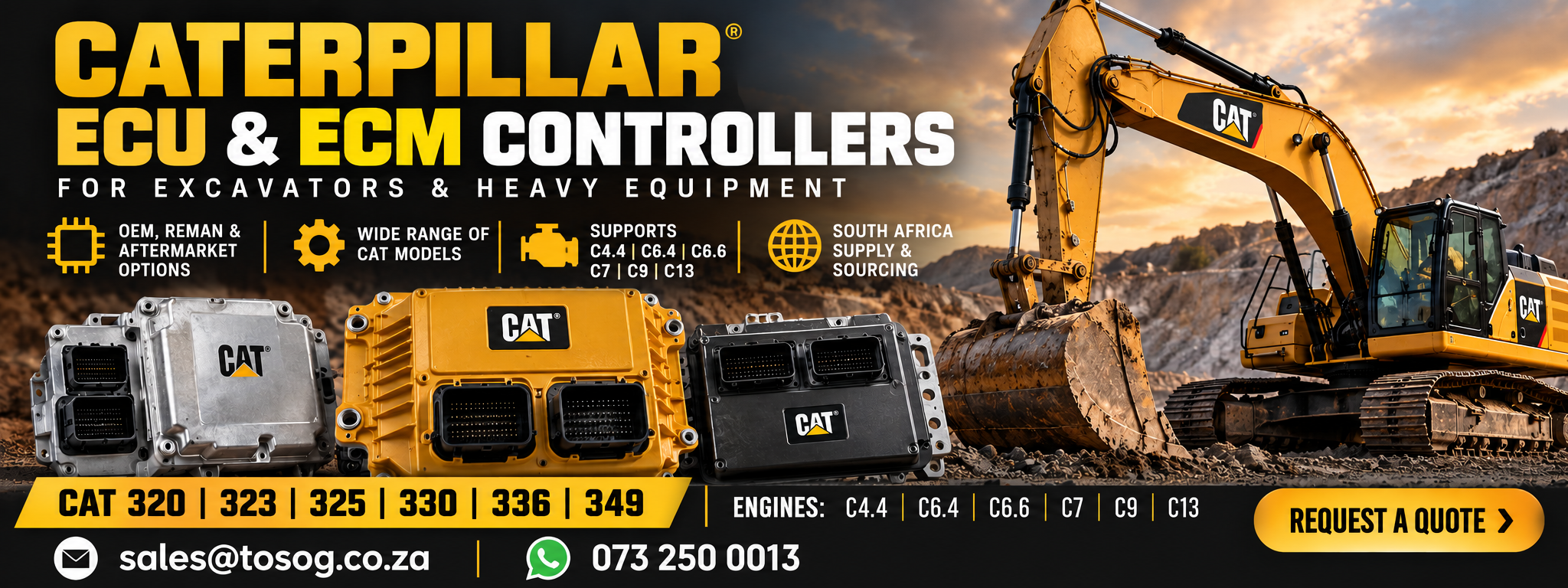 CAT ECU & ECM for Sale in South Africa
Caterpillar ECU, ECM and electronic control modules for excavators and heavy equipment in South Africa. TOSOG Yellow Plant Solutions sources OEM, replacement, remanufactured and aftermarket CAT ECU/ECM controllers for Caterpillar excavators, engines and construction equipment.
We supply and source Caterpillar engine control modules, electronic control units, machine control modules and ECU computer boxes for a wide range of CAT excavator models, including CAT 320, 323, 325, 330, 336 and 349, subject to model, serial number, engine configuration and controller specification.
Our sourcing range includes controllers used with Caterpillar engines such as C4.4, C6.4, C6.6, C7, C9 and C13, as well as other electronic systems used on CAT heavy equipment.
Looking for a CAT ECM or ECU? Send us your machine model, serial number, engine model and the part number on your existing controller. We can assist with identifying the correct replacement or sourcing option.
Caterpillar ECU & ECM Controllers
Modern Caterpillar excavators rely on electronic control systems to manage engine operation, fuel systems, machine functions, monitoring and communication between electronic components.
Depending on the machine, an ECU or ECM may be responsible for functions including:
- Engine control
- Fuel injection management
- Engine monitoring
- Electronic throttle control
- Hydraulic system communication
- Machine control functions
- Sensor signal processing
- CAN bus communication
- Fault-code monitoring
- Diagnostic communication
- Machine performance management
- Communication with other electronic control modules
A failed or incorrectly specified controller can result in starting problems, fault codes, reduced machine performance or communication faults.
For this reason, ECU/ECM compatibility must be confirmed before ordering.
CAT Excavator ECU & ECM Models
We source and supply ECU and ECM solutions for Caterpillar excavators across multiple generations and model families.
Caterpillar 300 Series Excavators
Depending on configuration, our sourcing range includes controllers for:
- CAT 312
- CAT 313
- CAT 314
- CAT 315
- CAT 318
- CAT 320
- CAT 321
- CAT 322
- CAT 323
- CAT 324
- CAT 325
- CAT 326
- CAT 329
- CAT 330
- CAT 336
- CAT 340
- CAT 345
- CAT 349
Availability and compatibility depend on the exact machine configuration.
CAT 320 ECU / ECM
We source CAT 320 ECU and CAT 320 ECM controllers for different machine generations, including earlier 320 models, 320D, 320D2, 320F, 320GC and Next Generation configurations.
CAT 323 ECU / ECM
Our sourcing range includes CAT 323 ECU and ECM controllers for selected 323C, 323D, 323E, 323F, 323GC and Next Generation configurations.
CAT 325 ECU / ECM
We source CAT 325 engine ECMs and electronic control modules for selected 325C, 325D, 325F, 325GC and newer machine configurations.
CAT 330 ECU / ECM
We source CAT 330 ECU and ECM computer boxes for selected 330C, 330D, 330E, 330F, 330GC and newer configurations.
CAT 336 ECU / ECM
We supply and source CAT 336 ECM and ECU controllers for selected 336D, 336E, 336F, 336GC and Next Generation machines.
CAT 349 ECU / ECM
We also source CAT 349 ECU and ECM controllers for selected 349 and 349GC configurations.
Caterpillar Excavator Series
Our sourcing capability covers electronic controllers used across different Caterpillar excavator generations, including:
| CAT Series | Examples |
|---|---|
| B-Series | CAT 320B, 325B, 330B |
| C-Series | CAT 320C, 325C, 330C |
| D-Series | CAT 312D, 320D, 323D, 325D, 330D, 336D |
| D2-Series | CAT 320D2 and related configurations |
| E-Series | CAT 320E, 323E, 330E |
| F-Series | CAT 320F, 323F, 325F, 330F, 336F |
| GC-Series | CAT 320GC, 323GC, 325GC, 330GC, 336GC, 349GC |
| Next Generation | Selected CAT Next Generation excavators |
Important: The machine model alone is not always sufficient to identify an ECU or ECM. Caterpillar controllers can vary according to serial number, engine arrangement, software, machine configuration and application.
Caterpillar Engine ECMs
We source electronic control modules for Caterpillar-powered equipment using a range of CAT engines.
Examples include:
- Caterpillar C4.4 ECM
- Caterpillar C6.4 ECM
- Caterpillar C6.6 ECM
- Caterpillar C7 ECM
- Caterpillar C9 ECM
- Caterpillar C13 ECM
- Other Caterpillar electronically controlled engines
A replacement engine ECM may require specific configuration, programming, calibration or compatibility checks before installation.
CAT ECU vs CAT ECM – What Is the Difference?
The terms ECU and ECM are often used interchangeably in the heavy-equipment parts market, but they can refer to different control systems.
ECU – Electronic Control Unit
An ECU is a general term for an electronic control unit responsible for controlling or communicating with a particular machine system.
ECM – Engine Control Module
An ECM generally refers specifically to the electronic controller responsible for engine-related functions.
Depending on the Caterpillar machine, you may also encounter terminology such as:
- Engine ECM
- Machine ECM
- Machine ECU
- Electronic Control Module
- Electronic Control Unit
- Controller
- Computer Box
- Engine Controller
- Machine Controller
When searching for a replacement, the controller’s part number and machine information are more important than the terminology used in the search.
CAT ECU & ECM Part Numbers
Our catalogue and sourcing database includes Caterpillar controller references such as:
- 221-8874
- 326-4635
- 331-7539
- 366-8821
- 430-7160
Additional Caterpillar ECU and ECM references are available depending on the machine and application.
Before ordering
Please provide:
- CAT machine model
- Machine serial number
- Engine model
- Engine serial number where applicable
- Existing ECU/ECM part number
- Photographs of the controller label
- Description of the fault, if known
This information allows us to investigate the correct controller and available sourcing options.
OEM, Remanufactured & Aftermarket CAT ECM Options
Depending on availability and machine requirements, TOSOG can source different categories of electronic controllers.
OEM Controllers
Original-equipment controllers intended for the relevant Caterpillar application.
Remanufactured Controllers
Remanufactured units may provide an alternative where an original replacement is unavailable or costly.
Aftermarket Replacement Controllers
Aftermarket alternatives may be available for selected machines and applications.
Not every aftermarket or remanufactured ECM is automatically interchangeable with an OEM unit. Compatibility should be confirmed before purchase.
CAT ECU / ECM Faults & Replacement
Electronic controller failure can be associated with symptoms such as:
- Engine does not start
- Intermittent starting
- Communication faults
- ECU/ECM fault codes
- Loss of engine communication
- Sensor-related faults
- Reduced engine performance
- Incorrect machine operation
- Intermittent machine shutdown
- CAN communication errors
- Controller not communicating with diagnostic equipment
However, these symptoms do not automatically mean the ECU or ECM has failed.
Wiring, power supply, grounds, connectors, sensors, CAN communication and other control modules should also be checked before replacing an expensive controller.
How to Identify the Correct CAT ECM
The fastest way to identify a Caterpillar ECU or ECM is to send us a clear photograph of the controller identification label.
The label may contain:
- Caterpillar part number
- Serial number
- Controller identification
- Manufacturer number
- Hardware information
- Software information
- Other identification codes
Send us the following:
Machine: CAT 320D
Serial Number: XXXXX
Engine: C6.4
ECM Part Number: XXXXX
Quantity: 1
Location: South Africa
We can then investigate the appropriate sourcing option.
CAT ECU & ECM Supply in South Africa
TOSOG supplies and sources heavy-equipment electronic components for customers in South Africa.
We support customers requiring Caterpillar electronic control modules for:
- Construction equipment
- Earthmoving equipment
- Mining equipment
- Plant hire fleets
- Contractors
- Workshops
- Equipment rebuilders
- Diesel mechanics
- Heavy-equipment repair companies
Our parts-on-demand process is simple:
Identify → Quote → Confirm → Source → Supply
For imported or specially sourced electronic components, lead times depend on supplier availability, international freight and customs clearance.
Why Use TOSOG for CAT Electronic Controllers?
TOSOG focuses on sourcing yellow plant and heavy-equipment parts and components for customers requiring replacement and aftermarket solutions.
Our sourcing service can assist with:
- CAT ECU sourcing
- CAT ECM sourcing
- Engine controller sourcing
- Machine controller sourcing
- Electronic module identification
- Part-number cross-reference investigation
- OEM sourcing
- Remanufactured sourcing
- Aftermarket sourcing
- International supplier sourcing
CAT ECU / ECM Buying Tips
1. Do not order using the machine model alone
A CAT 320, for example, can have different controller configurations depending on the generation, serial number and engine.
2. Check the controller part number
Always compare the part number on the existing controller where possible.
3. Send photographs
Clear photographs of the front, back and identification label can significantly improve identification.
4. Confirm the engine
The engine model can be critical when sourcing an engine ECM.
5. Check programming requirements
Some replacement controllers may require programming, configuration, calibration or other setup procedures.
6. Investigate the original fault
A controller should not automatically be replaced simply because a machine has an electronic fault code.
7. Confirm compatibility before payment
Final compatibility should be confirmed against the machine information and controller identification before an order is processed.
Frequently Asked Questions
Do you sell CAT ECU and ECM controllers?
Yes. TOSOG sources Caterpillar ECU, ECM and electronic control modules for selected excavators and heavy equipment.
Do you supply CAT 320 ECMs?
Yes. We source CAT 320 ECU and ECM controllers for various generations and configurations, subject to identification and availability.
Do you supply CAT 330 ECMs?
Yes. We can source CAT 330 ECU and ECM controllers for selected machine configurations.
Do you supply CAT 336 ECMs?
Yes. CAT 336 ECU and ECM controllers can be sourced for selected D, E, F, GC and newer configurations.
Can you identify my CAT ECM?
Yes. Send us the machine model, serial number, engine information and photographs of the controller label.
Can you supply a replacement for a failed CAT ECM?
We can investigate OEM, remanufactured and aftermarket replacement options, depending on the application and availability.
Does a replacement CAT ECM need programming?
Depending on the machine and controller, programming, configuration, calibration or other commissioning procedures may be required. This should be confirmed for the specific application.
Do you supply used CAT ECMs?
Availability of used controllers depends on current sourcing. Ask us to check the specific part number.
Do you supply CAT ECU parts in South Africa?
Yes. TOSOG is based in South Africa and sources heavy-equipment electronic components for local customers.
How do I request a quotation?
Send the following information via WhatsApp or email:
CAT Machine Model + Serial Number + Engine Model + ECM/ECU Part Number + Quantity + Photos
Request a Caterpillar ECU / ECM Quote
Looking for a CAT ECU, CAT ECM, Caterpillar engine controller or excavator computer box?
Send us the controller details and machine information.
TOSOG Yellow Plant Solutions
CAT ECU | CAT ECM | Caterpillar ECM | Caterpillar ECU | CAT Excavator ECM | CAT Engine Control Module | CAT Machine Controller | CAT Computer Box
Caterpillar ECU & ECM Troubleshooting Guidelines
Before replacing a Caterpillar ECU or ECM, it is important to establish whether the controller is actually faulty. An engine or excavator electronic fault can also be caused by wiring, power supply, sensors, communication networks, connectors or another control module.
Use the following troubleshooting guidelines as a starting point.
1. Machine Will Not Start
If the Caterpillar excavator does not start:
- Check battery voltage.
- Check battery terminals and earth/ground connections.
- Check ECU/ECM power supply.
- Check ECM fuses and relays.
- Inspect ECM connectors for corrosion, water ingress or damaged pins.
- Check wiring between the ECM and engine sensors.
- Check the engine stop/shutdown circuit.
- Check CAN communication where applicable.
- Use suitable diagnostic equipment to retrieve active and logged fault codes.
Do not replace the ECM solely because the machine does not start.
2. ECM or ECU Is Not Communicating
If diagnostic equipment cannot communicate with the controller:
- Check battery voltage.
- Confirm power and ground at the ECM.
- Check ECM-related fuses and relays.
- Inspect the ECM connectors.
- Check for damaged, loose or corroded terminals.
- Inspect CAN/J1939 communication wiring where applicable.
- Check for short circuits on the communication network.
- Confirm that the diagnostic connector and communication interface are functioning correctly.
- Verify that the diagnostic tool is configured for the machine and controller.
A communication failure does not necessarily mean that the ECM itself has failed.
3. Intermittent ECU / ECM Faults
Intermittent faults can be particularly difficult to diagnose.
Check for:
- Loose connectors
- Damaged wiring
- Chafed harnesses
- Water or oil contamination
- Corroded terminals
- Poor grounding
- Battery voltage fluctuations
- Alternator charging problems
- CAN communication interruptions
- Poor connections around sensors
- Previous wiring repairs
Inspect the wiring harness carefully, particularly around areas exposed to vibration, heat, oil, water and movement.
4. Active or Logged Fault Codes
Record all diagnostic fault codes before clearing them.
When investigating a fault code, check:
Fault code → Related component → Wiring → Power supply → Ground → Connector → Sensor/control signal → ECM
A fault code identifying a sensor does not automatically mean the sensor is defective. The fault may be caused by the sensor wiring, connector, power supply, ground or communication circuit.
Keep a record of:
- Active fault codes
- Logged fault codes
- Machine hours
- Machine serial number
- Engine model
- Engine serial number
- ECM part number
- Symptoms experienced
- Conditions under which the fault occurs
5. Engine Performance Problems
If the engine is running but performance is poor, investigate:
- Fuel supply
- Fuel filters
- Air intake restrictions
- Turbocharger system
- Engine sensors
- Fuel injectors
- Wiring harness
- Battery voltage
- ECM power and ground
- Diagnostic fault codes
- Communication between electronic modules
An ECM replacement should generally be considered only after other possible causes have been investigated.
6. ECU / ECM Connector Inspection
Before condemning an electronic controller, inspect the connector carefully.
Look for:
- Bent pins
- Broken pins
- Recessed terminals
- Loose terminals
- Corrosion
- Water ingress
- Oil contamination
- Damaged seals
- Broken connector locks
- Wiring pulled from terminals
Never force an electrical connector onto an ECM.
7. Check ECM Power and Ground
A controller may appear to be defective when the actual problem is its power or ground circuit.
Verify:
- Battery supply
- Switched power
- ECM ground
- Fuse condition
- Relay operation
- Voltage drop
- Ground connection integrity
Voltage should be checked under appropriate operating conditions rather than relying only on a static battery-voltage measurement.
8. Check the Wiring Harness
Inspect the harness between the ECM and connected components.
Pay particular attention to:
- Engine harnesses
- Sensor wiring
- Injector circuits
- CAN/J1939 communication wiring
- Ground circuits
- Power supply circuits
- Areas close to the engine
- Areas exposed to heat and vibration
Look for insulation damage, broken conductors, chafing and previous repairs.
9. CAN / J1939 Communication Troubleshooting
Where the machine uses CAN or J1939 communication, communication faults can prevent different electronic modules from communicating correctly.
Investigate:
- CAN wiring
- Connectors
- Termination
- Power supply
- Ground connections
- Short circuits
- Open circuits
- Damaged harness sections
- Other modules connected to the network
A single faulty module or wiring fault can sometimes affect communication with other controllers.
10. When Should the CAT ECM Be Replaced?
Consider replacing or sourcing an ECM only after appropriate diagnostic checks have been completed.
Before ordering a replacement, obtain:
Machine Model:
Machine Serial Number:
Engine Model:
Engine Serial Number:
Existing ECM/ECU Part Number:
Fault Codes:
Quantity Required:
Photos of Existing Controller:
This information helps TOSOG investigate the correct replacement and available sourcing options.
11. Replacement ECM Compatibility
Do not assume that two Caterpillar ECMs are interchangeable simply because they look identical or have similar part numbers.
Compatibility may depend on:
- Machine model
- Machine serial number
- Engine model
- Engine arrangement
- Controller part number
- Hardware configuration
- Software
- Calibration
- Machine configuration
Where applicable, a replacement controller may require programming, configuration, calibration or commissioning before the machine can operate correctly.
12. Send Us Your CAT ECM Details
If you are troubleshooting a Caterpillar ECU or ECM problem, send TOSOG:
📸 Photos of the ECM label
🔢 ECM part number
🚜 CAT machine model
🔧 Machine serial number
⚙️ Engine model
⚠️ Fault codes
📦 Quantity required
Our team can investigate the available OEM, remanufactured or aftermarket CAT ECU/ECM sourcing options.
TOSOG Yellow Plant Solutions
Email: sales@tosog.co.za
WhatsApp: 073 250 0013
CAT ECU | CAT ECM | Caterpillar ECM | CAT Excavator ECM | CAT Engine Controller | CAT Machine ECU | CAT Computer Box