
Yellow Plant Machinery Parts – New, Used & Aftermarket Earthmoving Parts
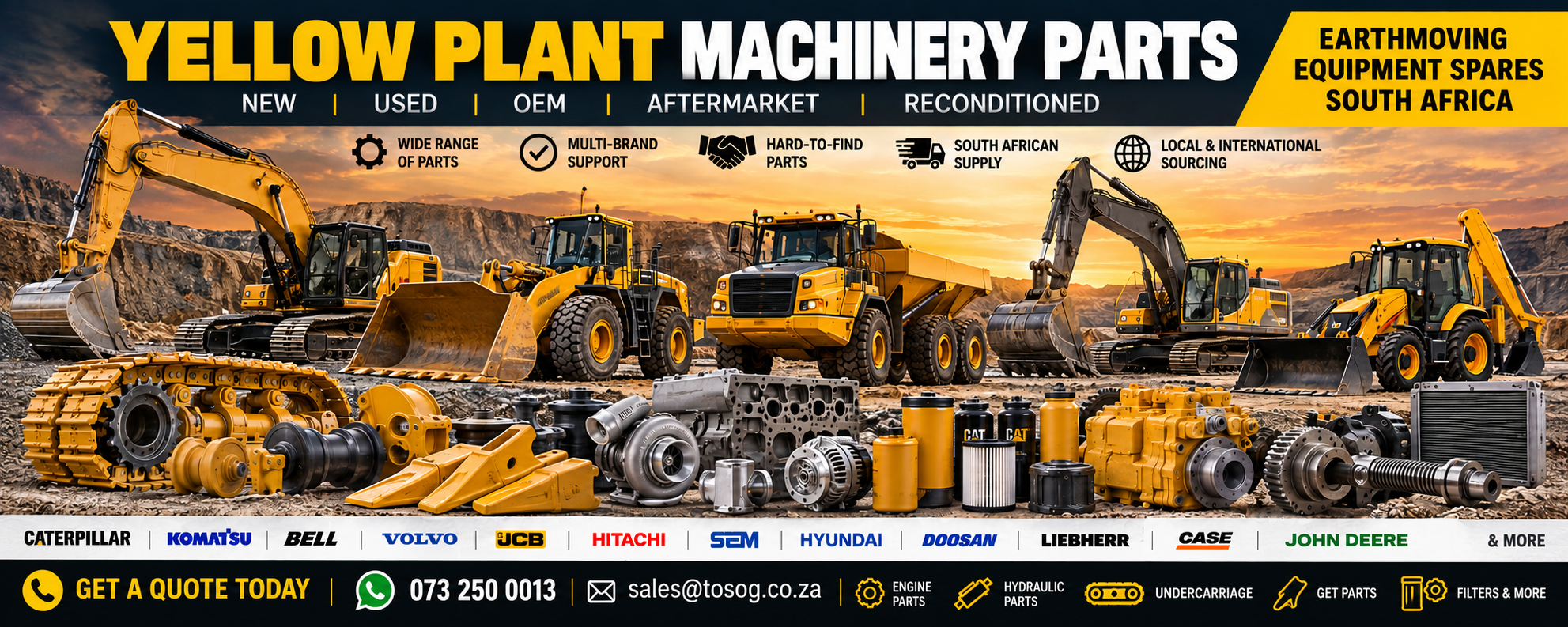 Yellow Plant Machinery Parts South Africa | Earthmoving Equipment Spares
TOSOG Yellow Plant Solutions supplies yellow plant machinery parts, earthmoving machinery parts and heavy equipment spares in South Africa for construction, mining, quarrying, roadworks, civil engineering, agriculture and plant hire operations.
We source and supply new, used, OEM, aftermarket, remanufactured and reconditioned yellow plant parts for a wide range of leading construction and mining machinery manufacturers.
Whether you need a CAT excavator part, Komatsu wheel loader component, Bell ADT part, Volvo construction equipment spare, JCB TLB component, Hitachi excavator part or SEM loader spare, TOSOG can assist with sourcing the correct component for your machine.
Need a yellow plant part? Send us the machine make, model, serial number/PIN and part number for a quotation.
Yellow Plant Parts & Earthmoving Machinery Parts
Yellow plant machinery operates in some of the toughest working environments in South Africa. Construction sites, mines, quarries and road projects require reliable equipment and fast access to replacement components.
At TOSOG, we supply a comprehensive range of yellow plant spare parts for:
- Excavators
- Wheel loaders
- Bulldozers
- Motor graders
- Articulated dump trucks
- Rigid dump trucks
- TLBs / backhoe loaders
- Skid steer loaders
- Track loaders
- Compactors and rollers
- Scrapers
- Telehandlers
- Mining equipment
- Drilling equipment
- Crushing and screening equipment
Our parts range covers mechanical, hydraulic, electrical, electronic, drivetrain and wear components.
Yellow Plant Machinery Parts We Supply
1. Engine Parts
We supply replacement and overhaul components for diesel engines used in earthmoving and construction machinery.
Available engine components include:
- Diesel injectors
- Injector pumps
- Fuel pumps
- Turbochargers
- Water pumps
- Oil pumps
- Pistons
- Piston rings
- Cylinder liners
- Connecting rods
- Crankshafts
- Camshafts
- Bearings
- Gaskets
- Cylinder heads
- Engine blocks
- Radiators
- Fan assemblies
- Thermostats
- Belts
- Engine overhaul kits
We can assist with sourcing complete engines and replacement engine assemblies where required.
2. Hydraulic Parts for Yellow Plant
Hydraulic systems are critical to excavators, loaders, graders, dozers and other heavy machinery.
TOSOG supplies and sources:
- Hydraulic pumps
- Hydraulic motors
- Hydraulic valves
- Main control valves
- Pilot valves
- Relief valves
- Solenoid valves
- Hydraulic cylinders
- Cylinder seal kits
- Hydraulic hoses
- Hydraulic fittings
- Hydraulic filters
- Hydraulic pumps and motors
- Swing motors
- Travel motors
- Pilot pumps
- Hydraulic control components
We support hydraulic component sourcing for major brands and machine models.
3. Final Drives & Travel Motors
TOSOG supplies final drives, travel motors and planetary drive components for excavators and other tracked machines.
We can source:
- Complete final drives
- Final drive motors
- Travel motors
- Planetary gear assemblies
- Reduction gearboxes
- Drive sprockets
- Bearings
- Seals
- Gear sets
- Final drive repair kits
When requesting a final drive, provide the machine model, serial number and existing final drive information wherever possible.
4. Transmission & Drivetrain Parts
Transmission and drivetrain components are essential for wheel loaders, dump trucks, ADTs and other heavy equipment.
Our range includes:
- Transmissions
- Gearboxes
- Torque converters
- Transmission pumps
- Transmission valves
- Clutch components
- Transmission filters
- Axles
- Differentials
- Differential gears
- Planetary gears
- Propshafts
- Drive shafts
- Universal joints
- Transmission control modules
5. Undercarriage Parts
TOSOG supplies earthmoving machinery undercarriage parts for tracked excavators, bulldozers and track loaders.
Available components include:
- Track chains
- Track links
- Track shoes
- Track groups
- Track bolts and nuts
- Carrier rollers
- Bottom rollers
- Top rollers
- Track rollers
- Front idlers
- Sprockets
- Segment groups
- Track adjusters
- Track frames
- Undercarriage hardware
Correct undercarriage selection is important because different machine generations can use different track configurations.
6. Ground Engaging Tools – GET
Ground Engaging Tools are among the most frequently replaced yellow plant wear parts.
We supply:
- Bucket teeth
- Tooth adapters
- Bucket shrouds
- Side cutters
- Cutting edges
- End bits
- Dozer blades
- Grader blades
- Ripper teeth
- Ripper shanks
- Pins and retainers
- Wear plates
GET components are available for excavators, loaders, dozers, graders and other earthmoving machinery.
7. Electrical & Electronic Parts
Modern yellow plant machinery contains sophisticated electronic control systems.
TOSOG can source:
- ECUs
- ECMs
- Machine controllers
- Transmission control units
- Engine control modules
- Monitor panels
- Displays
- Sensors
- Pressure sensors
- Temperature sensors
- Speed sensors
- Wiring harnesses
- Alternators
- Starters
- Solenoids
- Relays
- Switches
- Control modules
- Communication modules
For electronic components, always provide the exact part number and machine serial number before ordering.
8. Cooling System Parts
Overheating can result in significant equipment downtime.
We supply:
- Radiators
- Oil coolers
- Hydraulic oil coolers
- Charge-air coolers
- Intercoolers
- Fan assemblies
- Fan motors
- Water pumps
- Thermostats
- Radiator hoses
- Cooling system components
9. Filters & Service Kits
Regular maintenance is essential for heavy equipment operating in dusty and demanding South African conditions.
We supply:
- Engine oil filters
- Fuel filters
- Hydraulic filters
- Air filters
- Transmission filters
- Water separators
- Breathers
- Filter kits
- Service kits
- Maintenance kits
Yellow Plant Machinery Models We Support
TOSOG supplies and sources parts for many popular yellow plant machinery models used in South Africa.
Caterpillar / CAT
Examples include:
- CAT 320
- CAT 320D
- CAT 320D2
- CAT 320GC
- CAT 323
- CAT 336
- CAT 950
- CAT 966
- CAT 966L
- CAT 980
- CAT 428
- CAT 745
- CAT 777
- CAT D6
- CAT D7
- CAT D8
- CAT 140H
- CAT 140K
- CAT 963
- CAT 627
Komatsu
Examples include:
- Komatsu PC200
- Komatsu PC210
- Komatsu PC300
- Komatsu PC350
- Komatsu PC400
- Komatsu PC450
- Komatsu WA380
- Komatsu WA470
- Komatsu WA480
- Komatsu WA600
- Komatsu WA900
- Komatsu WA1200
- Komatsu D65
- Komatsu D85
- Komatsu D155
- Komatsu GD675
- Komatsu HD465
- Komatsu HD605
- Komatsu HD785
Bell Equipment
Parts can be sourced for models including:
- Bell B25
- Bell B30
- Bell B35
- Bell B40
- Bell B40D
- Bell B45
- Bell B45E
- Bell B50
- Bell B50E
- Bell L-series loaders
- Bell graders
Volvo Construction Equipment
Examples include:
- Volvo EC210
- Volvo EC220
- Volvo EC300
- Volvo EC350
- Volvo L90
- Volvo L110
- Volvo L120
- Volvo L150
- Volvo L180
- Volvo A25
- Volvo A30
- Volvo A35
- Volvo A40
JCB
Examples include:
- JCB 3CX
- JCB 4CX
- JCB 426
- JCB 427
- JCB 437
- JCB JS130
- JCB JS160
- JCB JS200
- JCB JS220
- JCB JS300
- JCB telehandlers
- JCB compact equipment
Hitachi
Examples include:
- Hitachi ZX200
- Hitachi ZX210
- Hitachi ZX240
- Hitachi ZX250
- Hitachi ZX300
- Hitachi ZX350
- Hitachi ZX470
- Hitachi EX series
SEM
TOSOG also supplies and sources parts for SEM yellow plant machinery, including:
- SEM 616
- SEM 636
- SEM 636B
- SEM 656
- SEM 656D
- SEM 660
- SEM 660D
- SEM motor graders
- SEM bulldozers
Other Machinery Brands
We can also source parts for:
- Hyundai
- Doosan / DEVELON
- Liebherr
- CASE
- John Deere
- SANY
- XCMG
- SDLG
- Shantui
- Terex
- Bobcat
- Bomag
- Dynapac
- Hamm
- Manitou
Major Yellow Plant Parts Manufacturers & Brands
TOSOG works with a broad network of manufacturers and suppliers to source suitable replacement components.
Construction & Mining Machinery Brands
- Caterpillar / CAT
- Komatsu
- Bell Equipment
- Volvo CE
- Hitachi
- JCB
- Hyundai
- Doosan / DEVELON
- Liebherr
- CASE
- John Deere
- SEM
- SANY
- XCMG
- SDLG
- Shantui
- Terex
Component Manufacturers
Depending on the application, we can source components and systems associated with manufacturers such as:
- Cummins
- Perkins
- Caterpillar
- Deutz
- Volvo Penta
- Weichai
- ZF
- Dana
- Bosch
- Parker
- Eaton
- Rexroth
- Kawasaki
- KYB
- Nabtesco
- Donaldson
- Fleetguard
Manufacturer availability depends on the specific machine, component and part number.
New, Used, OEM & Aftermarket Yellow Plant Parts
We understand that every fleet has different operating and budget requirements.
TOSOG can assist with:
Genuine OEM Parts
Original manufacturer components specified for the machine.
Aftermarket Parts
Replacement components manufactured as alternatives to original parts.
Used Parts
Cost-effective components for suitable applications and older machines.
Reconditioned & Remanufactured Components
Components that have been rebuilt or reconditioned for continued service.
The appropriate option depends on the application, machine condition, operating environment, budget and required service life.
Why Choose TOSOG for Yellow Plant Parts?
Parts-on-Demand Sourcing
If the required component is not immediately available, our sourcing network allows us to investigate local and international supply options.
Multi-Brand Support
We work across numerous yellow plant and earthmoving machinery brands.
Hard-to-Find Parts
We assist with obsolete, discontinued and difficult-to-source components where supplier availability allows.
Part Number Cross-Referencing
Providing an OEM part number allows us to investigate compatible sourcing options.
South African Supply
TOSOG supplies customers across South Africa, with collection and delivery options depending on the order.
How to Order Yellow Plant Machinery Parts
For a fast quotation, send us as much of the following information as possible:
1. Machine manufacturer
Example: Caterpillar
2. Machine model
Example: CAT 320D
3. Serial number / PIN
This is extremely important for accurate identification.
4. Part number
If available, provide the original OEM part number.
5. Description
Example: Hydraulic pump, final drive, injector or radiator.
6. Quantity required
7. Photos
Photos of the existing component, identification plate and part number can assist with identification.
Send your RFQ to:
📱 WhatsApp: 073 250 0013
📧 sales@tosog.co.za
Tips for Buying Yellow Plant Machinery Parts
1. Always Provide the Machine Serial Number
The same machine model can have different components depending on the production year, serial number and configuration.
2. Check the Part Number
The part number is one of the fastest ways to identify the correct component.
3. Do Not Buy on Appearance Alone
Two hydraulic pumps, ECUs, injectors or final drives may look similar but have different specifications.
4. Compare OEM and Aftermarket Options
Consider price, warranty, application, expected service life and availability before selecting a component.
5. Check Related Components
When replacing a major component, inspect related parts.
For example, when replacing a final drive, inspect the sprocket, undercarriage and hydraulic system.
6. Keep Critical Spares Available
Mining and construction operations should consider maintaining stock of high-failure or critical components such as:
- Filters
- Sensors
- Belts
- Hoses
- GET
- Seals
- Electrical components
- Hydraulic components
7. Verify Before Payment
For expensive components, confirm the machine model, serial number, part number, specifications and quotation before placing the order.
Yellow Plant Parts for Mining & Construction
Mining and construction equipment operates under demanding conditions involving dust, vibration, heavy loads, extreme temperatures and long operating hours.
TOSOG supplies parts for equipment used in:
- Open-pit mining
- Coal mining
- Quarrying
- Road construction
- Civil engineering
- Building construction
- Earthworks
- Agricultural earthworks
- Plant hire
- Infrastructure projects
- Material handling
Reliable access to replacement parts helps reduce unnecessary equipment downtime and supports fleet maintenance programmes.
Frequently Asked Questions – Yellow Plant Machinery Parts
What are yellow plant machinery parts?
Yellow plant machinery parts are replacement components used on heavy construction, mining and earthmoving equipment such as excavators, loaders, bulldozers, graders, dump trucks and TLBs.
Where can I buy yellow plant parts in South Africa?
TOSOG supplies and sources yellow plant machinery parts and earthmoving equipment spares in South Africa. Customers can contact us with the machine model, serial number and part number for a quotation.
What yellow plant brands do you supply?
We supply or source parts for major brands including CAT, Komatsu, Bell, Volvo, Hitachi, JCB, SEM, Hyundai, Doosan, Liebherr, CASE, John Deere, SANY, XCMG and SDLG, subject to availability.
Do you sell CAT parts?
Yes. TOSOG can source and supply a wide range of Caterpillar / CAT parts, including engine components, hydraulic parts, undercarriage, transmissions, final drives, electrical components and GET.
Do you supply Komatsu parts?
Yes. We supply and source Komatsu earthmoving machinery parts for excavators, wheel loaders, dozers, graders and mining equipment.
Do you supply Bell Equipment parts?
Yes. We can source and supply parts for Bell articulated dump trucks, loaders, graders and other Bell equipment, subject to model and part availability.
Do you supply used yellow plant parts?
Yes. Depending on availability, used and reconditioned components may be sourced as an alternative to new parts.
Can you source obsolete yellow plant parts?
We can investigate hard-to-find and discontinued components through our supplier network. Availability depends on the machine and component.
What information do you need for a quotation?
Ideally provide the manufacturer, machine model, serial number/PIN, part number, description, quantity and photos.
Can you identify a part from a photograph?
In many cases, photographs can help with initial identification. For accurate confirmation, the machine serial number and part number are strongly recommended.
Do you supply hydraulic pumps?
Yes. We source hydraulic pumps, hydraulic motors, valves, pilot pumps and related hydraulic components for earthmoving machinery.
Do you supply final drives?
Yes. We can source complete final drives, travel motors and related planetary drive components for applicable machines.
Do you supply undercarriage parts?
Yes. Our range includes track chains, track shoes, rollers, idlers, sprockets, segments, track adjusters and associated components.
Do you supply ground engaging tools?
Yes. We supply bucket teeth, adapters, shrouds, cutting edges, side cutters, grader blades and other GET components.
How do I request a quotation?
Send your requirements to sales@tosog.co.za or WhatsApp 073 250 0013.
Get a Quote for Yellow Plant Machinery Parts
Need yellow plant parts in South Africa?
Whether you need a single replacement component or parts for an ongoing fleet maintenance programme, TOSOG can assist with sourcing suitable components for your earthmoving machinery.
Send us your machine details and part number today.
TOSOG Yellow Plant Solutions
Yellow Plant Machinery Parts | Earthmoving Machinery Parts | Heavy Equipment Spares | Construction & Mining Equipment Parts
Part numbers, manufacturer names and machine model references are used for identification and cross-reference purposes. Compatibility should be confirmed against the machine serial number/PIN and application before ordering.